
SEO vs. AEO: How Financial Advisors Can Show Up Where AI Is Giving the Answers

If you’re trying to build a steady pipeline of clients from online marketing, SEO has probably been part of your world for a while. It’s how people find you organically when they’re Googling retirement questions, tax strategies, or whether they really need a financial advisor.
Now, with the increased use of AI and LLMs, many advisors are asking how they can stay competitive and show up in the answers generated by AI as well.
To be clear, SEO is still incredibly important in 2026. More than half of all website traffic still comes from organic search. But what’s changing is how people search and what happens after they search.
Instead of scrolling through ten blue links, people are now asking full questions and expecting immediate answers. AI-driven tools like ChatGPT, Google’s AI overviews, Bing Chat, Perplexity, Gemini, and even voice assistants like Siri and Alexa are stepping in as the middleman…often without the user ever clicking through to a website.
That shift is where Answer Engine Optimization (AEO) comes in.
What Is AEO (and How Is It Different from SEO)?
Answer Engine Optimization is about structuring your content so AI tools can confidently pull your insight as the answer.
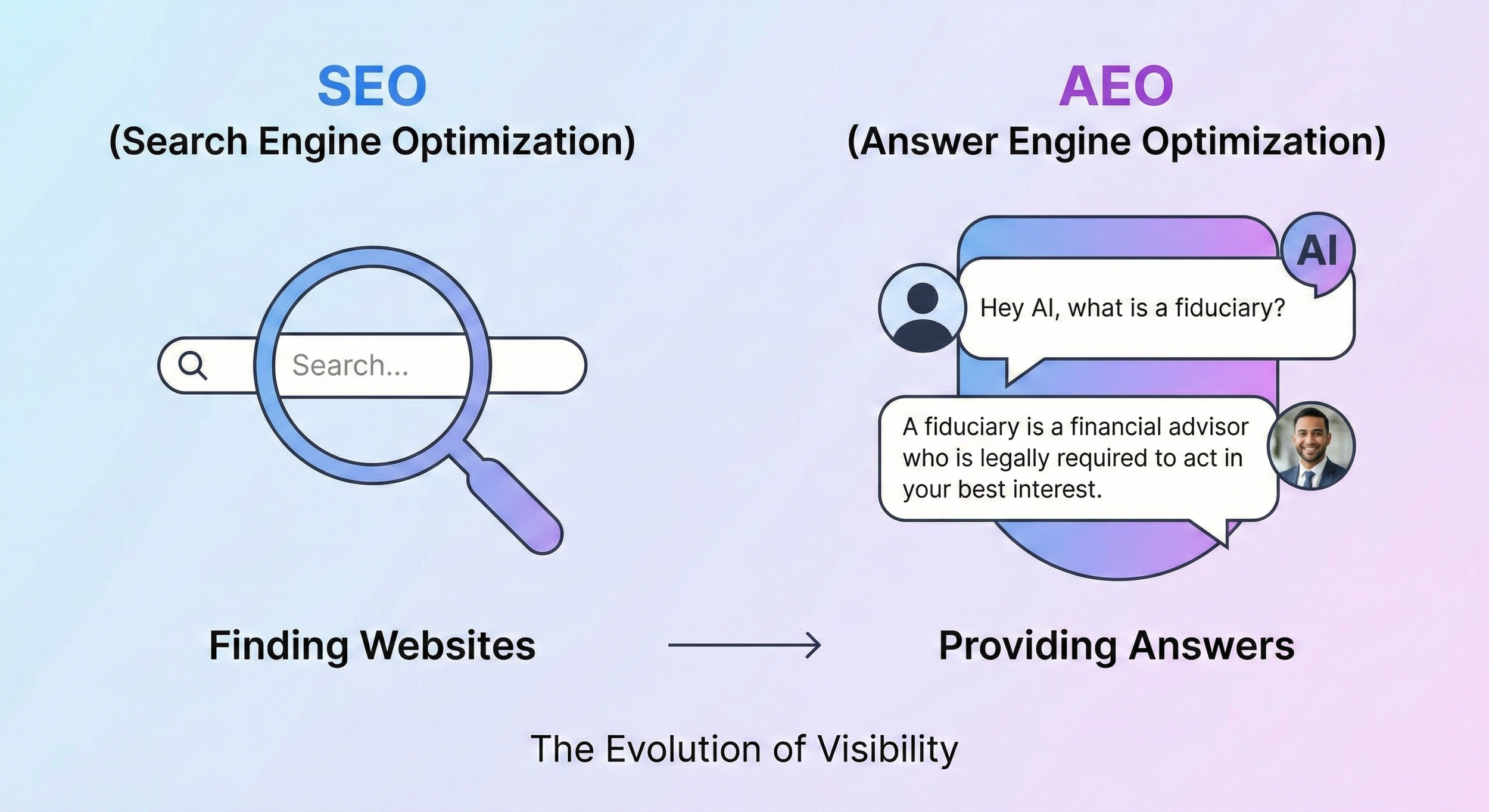
If SEO is about being found, AEO is about being quoted.
From my perspective, as someone who’s worked both as an advisor and now as a marketing strategist and fractional chief marketing officer (CMO) in the wealth management industry, AEO isn’t a replacement for SEO, but a natural extension of it.
The whole purpose of SEO has always been simple: help people find reliable, useful information as quickly as possible. AI tools and large language models are trying to do the exact same thing — just faster and more conversational.
That’s why most of what already makes your SEO strong also helps your AEO:
Helpful, educational content
Real answers to real client questions
Clear explanations
The difference is that AEO pushes you to think more intentionally about how people phrase questions and how directly you answer them.
Instead of only targeting broad keywords as you would for SEO, you now want to consider:
The exact questions clients ask in meetings
The way someone would say a question out loud
Short, clear answers that stand on their own
To increase your chances of showing up in the AI search result, it helps if these insights also show up as FAQs, Q&A sections, or blog headers written as actual questions.
SEO vs. AEO: The Key Differences
SEO (Search Engine Optimization)
SEO is about improving your visibility in traditional search results. It includes:
Keyword research
Page titles and meta descriptions
Internal links and site structure
Backlinks and authority
Technical basics like site speed and mobile friendliness
The goal is simple: rank well, drive traffic, and bring people to your website.
Success is usually measured by:
Organic traffic
Keyword rankings
Domain authority
AEO (Answer Engine Optimization)
AEO focuses on helping AI tools use your content as the answer. That means:
Answer quality first
Clear, concise, authoritative responses to specific questions.Conversational and voice-friendly phrasing
Content that mirrors how people actually talk, not how they type keywords.Structured data and schema
Helping machines understand what your content is answering.Zero-click visibility
Featured snippets, AI overviews, and answers that are easy to turn into voice answers.
Here’s the key distinction:
SEO tries to rank pages. AEO tries to answer questions. But both use the quality of the answer and the authority of the source in order to do this.
Why AEO Is Especially Important for Financial Advisor Marketing
The online marketing process is all about building trust before a prospect can feel comfortable even having that first conversation with you. This often happens even before they see your website. So if you answer a question that’s important to someone in a way that helps them take the next step, you’re starting the process of building that trust.
Here’s why AEO matters in the online marketing process:
1. You Show Up at High-Intent Moments
When someone asks, “Should I roll over my 401(k)?” or “How much can I safely withdraw in retirement?” they’re not browsing. They’re actually considering taking action. Appearing in those answers puts you in front of prospects at exactly the right time.
2. Authority by Association
When an AI tool selects your explanation as the answer, it subtly signals credibility. You didn’t say you’re an expert… but the platform implied it for you.
3. Voice Search Keeps Growing
More people are using voice — in the car, at home, on their phones. If your content sounds like something a human would say out loud, you’re far more likely to be included.
4. AI Isn’t Going Away
AI-powered search isn’t a trend. It’s a structural change in how people find information. Advisors who adapt early will stand out while others quietly disappear from view.
How Advisors Can Optimize for AEO (While Strengthening Their SEO)
1. Start with Real Questions, Not Just Keywords
First of all, the best place to start is to listen to your clients and prospects. Pay attention to questions that start with:
How
What
Why
Should I
What happens if
Make note of those queries and then also use tools like Ubersuggest, SEMrush, or Ahrefs to find high volume questions (questions that many people are already asking).
2. Lead with the Answer
AI tools love clarity.
When you write:
Put the short, direct answer first (about 40–60 words)
Then expand with context, examples, and nuance
Think: “Here’s the answer — now let me explain.”
3. Use Simple Structure and Schema
FAQ sections, clear headings, and basic schema markup make it easier for AI to understand what you’re answering. Most website platform SEO tools will allow you to structure content in these ways, or work with your web dev or IT team to help you.
4. Keep Your SEO Fundamentals Strong
AEO sits on top of authority. Backlinks, reviews, accurate business listings, and consistent branding will always matter! AI engines tend to trust sources that traditional search engines already trust.
5. Write Like You Speak
If you wouldn’t say it out loud to a client, rewrite it.
Phrases like:
“Should I…”
“What happens if…”
“How do I…”
These also help your content align with voice search and conversational queries.
6. Strengthen Third-Party Profiles
AI tools often pull data from credentialing bodies (such as the CFP Board) and trusted directories. Make sure your professional profiles are complete, current, and clearly describe who you help and how.
7. Refresh Content Regularly
Updating older posts, refreshing stats, and breaking long articles into Q&A snippets signals relevance — both to humans and to machines.
8. Measure Differently
AEO won’t always show up as a traffic spike. Watch impressions, featured snippets, and ask new clients how they found you. You will eventually start hearing, “I asked Google or ChatGPT…” more often.
SEO + AEO Works Best Together
The advisors who win online won’t choose between SEO or AEO. They’ll do both.
Strong websites with helpful content matter more than ever. And that content now needs to be structured so AI can easily extract insight and deliver it to users.
Whether someone is typing “financial advisor near me” or asking their phone “How do I choose a fiduciary advisor?” — your goal is to be present in both moments.
The difference between SEO and AEO comes down to how people search and how answers are delivered.
SEO helps people find your website.
AEO helps people find your expertise.
As AI reshapes search, advisors who focus on clear answers, real questions, and human language will stay visible and trusted. Start small: adjust how you write headlines, add FAQ sections, and answer questions the way you would in a client meeting.
Many financial advisors, RIAs, and wealth tech firms may have some of their content, vendors, and tools in place, but no one is steering the strategy. As a former advisor turned marketing leader, I help firms define priorities, align teams, and build a marketing engine that actually supports growth.
If you’re building in-house, reorganizing, or simply want clearer direction to help your business grow faster, I’m happy to talk. Click here to schedule a quick call.